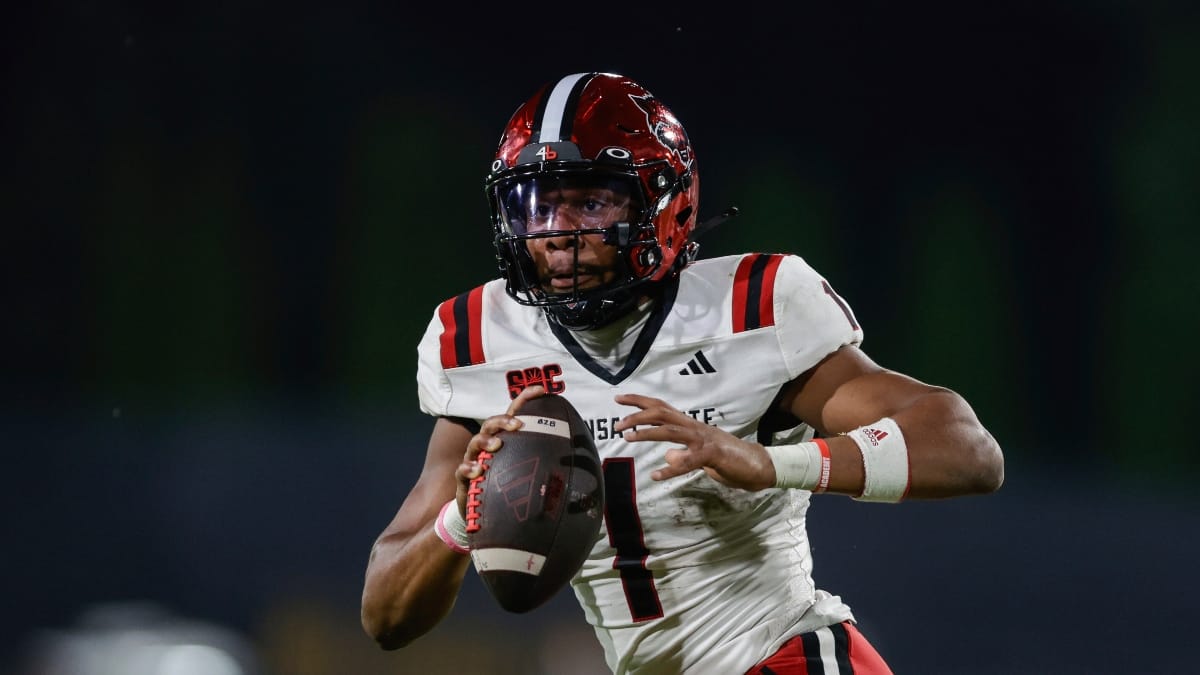


Coaching Candidate is a mini-series exploring potential head coaches at the FCS and FBS levels. Read more about the contracts and backgrounds of Bob Chesney, Ryan Silverfield, Charles Huff, Brent Vigen, Tim Polasek, Dan Mullen, and Jason Eck.
The rumors are hot and heavy right now around coaching candidate Alex Golesh — so much so that a report recently claimed he’d already interviewed at Oklahoma State. Naturally, he shut that down.
“I have not,” Golesh said when asked if he’s had an interview with Oklahoma State. “I’m so focused and locked in on this program and this team. We’ve got so much work to do. But I have not.”
This won’t be the last time, or the last school, his name pops up. In the three seasons before Golesh took over, USF posted a combined 4-29 record. Since his arrival, the Bulls are 21-15, steadily climbing, and he immediately delivered a 6-6 debut season — their first bowl-eligible campaign since 2018.
South Florida has lost a bit of shine as the year has gone on, but the full body of work remains impressive. They opened with back-to-back wins over then-Top 25 opponents Boise State and in-state rival Florida, and at multiple points, the Bulls controlled their own destiny to be the Group of Five representative in the College Football Playoff. Golesh did all of this while installing what he calls an “ultra fast offense,” the same breakneck system he helped refine at Tennessee.
Golesh also doesn’t come from a prototypical coaching tree. Born in Moscow, he immigrated to the U.S. at age seven, grew up in Ohio, and graduated from Ohio State. He’s a Russian-American who still speaks the language and takes pride in his heritage and upbringing.
Across 20 seasons, Golesh has climbed the collegiate ranks through eight FBS programs, earning a reputation as both a strong recruiter and a sharp offensive mind who helps spark turnarounds — Tennessee, Iowa State, Illinois, and Toledo among them.
His coaching path began as a student assistant at Ohio State before stops at Northern Illinois, Toledo, Oklahoma State, and Illinois.
His last three roles before arriving in “the Bay” were:
- 2016-2019: Iowa State (TE/Recruiting Coordinator)
- 2020: UCF (Co-OC/TE)
- 2021-2022: Tennessee (OC/TE)
At Iowa State, he spent Matt Campbell’s first four seasons as tight ends coach and recruiting coordinator, helping land the four highest-ranked recruiting classes in school history and supporting the turnaround that led from a 3-9 pre-Campbell season to multiple bowls and, eventually, a Fiesta Bowl run.
Before that, he helped Illinois jump from two wins to back-to-back bowl appearances (2012-15), and at Toledo, he helped take the Rockets from 3-9 to 8-5 and 9-4 while securing the MAC’s top-ranked recruiting classes in 2010 and 2011.
He also logged a season at UCF in 2020 as co-offensive coordinator, where the Knights finished top 10 nationally in total offense, passing yards, and scoring.

Alex Golesh Pay
Golesh is one of the higher-paid coaches in the American, and even though private-school data is spotty, it’s safe to say he sits in the upper tier. Of note, his base salary appears low ($500,000), mainly due to a Florida law limiting state-funded pay. As his contract states, “all amounts in excess of $200,000 will be paid from non-state funds.”
That’s why his true compensation comes through substantial “supplemental income” tied to University Advancement work — promotional events, fundraising, media appearances, and other program-facing duties. And if you’ve been following this series, you know this is mostly faux money — a mechanism schools use to pay coaches beyond state-funded caps or university optics limitations, not a sign that he’s moonlighting outside of football. As the contract puts it, “For these services, the University will pay Coach an annualized amount (‘Supplemental Compensation’).”
Alex Golesh Contract
Alex Golesh signed a six-year deal with South Florida running from Dec. 5, 2022 through Dec. 31, 2028.
Annual Compensation Breakdown
(Base salary + supplemental income)
- 2022 (pro-rated)
- Base Salary: $500,000 (annualized)
- Supplemental: $2,000,000 (annualized, pro-rated from Dec. 5)
- 2023 — Total: $2,500,000
- Base Salary: $500,000
- Supplemental: $2,000,000
- 2024 — Total: $2,500,000
- Base Salary: $500,000
- Supplemental: $2,000,000
- 2025 — Total: $2,500,000
- Base Salary: $500,000
- Supplemental: $2,000,000
- 2026 — Total: $2,600,000
- Base Salary: $500,000
- Supplemental: $2,100,000
- 2027 — Total: $2,600,000
- Base Salary: $500,000
- Supplemental: $2,100,000
- 2028 — Total: $2,600,000
- Base Salary: $500,000
- Supplemental: $2,100,000
Alex Golesh Buyout
- $3 million if he leaves before Jan. 1, 2024
- $2 million in 2024
- $1.5 million in 2025
- $1 million in 2026
- $750,000 in 2027
- $500,000 in 2028
Of note, Golesh does not have a fully guaranteed deal. If he’s fired without cause, he’s only protected for 20 weeks, not the full term. USF would owe him up to 20 weeks of base salary (not the supplemental money), with full mitigation if he lands another job. In other words, his safety net is relatively small compared to his peers — and if he stays after this cycle, you can assume that piece gets revisited in any renegotiated deal with USF.
Golesh and the Bulls still have two weeks left, and both UAB and Rice will be roadblocks to closing the season strong. With USF likely out of College Football Playoff contention as the Group of Five representative, it also coincidentally makes Golesh available a bit earlier for interested schools than he might have been had the Bulls made the playoff run many expected.