

North Dakota State has its answer.
The Bison and their fiercely loyal fan base have found a new football home in the Mountain West. For a program that has spent two decades redefining what dominance looks like at the FCS level, this was never really about if … it was about when.
Now, I won’t be shy about saying I felt and heard it was still at least another year out, but I’m absolutely thrilled for NDSU right now. In some ways, I think the MWC TV deal and other external factors accelerated the timeline.
From a financial and structural standpoint, we broke down the numbers a few months ago. The move made sense on paper. But beyond spreadsheets, entry fees, and television projections, this is about trajectory.
As Sam Herder noted, this feels like the next logical step.
Let’s take a spin in the real world for a minute.
If you’ve been one of the top performers at your company for nearly two decades, winning year after year, eventually you look for a new challenge. North Dakota State has been that employee. Ten national titles. A dynasty. A program that has become a benchmark for fundraising, facilities, culture, and fan engagement across the subdivision.
When you dominate a level that long, growth requires risk.
Will it be seamless? No.
The Bison will be competitive. I believe they will have the chance to compete from day one. But there will be reality checks. An early-season loss to Colorado or Arizona can change your entire postseason trajectory. Instead of competing for a national championship in Frisco, you may be playing in a bowl game in Frisco. No disrespect to the Frisco Bowl. It is a strong and fun event. But it does not carry the same gravity as competing for a national title.
That is the trade.

Why This Deal Works For Both Sides
I love this move for both parties.
It is time for North Dakota State. The desire is there. The ambition is there. Whether that desire evolves in five or ten years is a different conversation, but right now, the alignment makes sense.
And the Mountain West gets exactly what it wants.
A strong brand. A national following. A football program with credibility. An infusion of cash. And contractual protections.
Daniel Libit reported that North Dakota State’s membership agreement includes a clause requiring the program to maintain football spending that is “reasonably comparable” to the league average. If the Bison struggle competitively, they are required to increase football expenditures the following year to match or exceed conference peers.
In other words, the conference didn’t just add a member. It added a member with strong guardrails.
Financially, the structure is equally strategic and sensible.
Under the agreement, North Dakota State will pay a $12.5 million entry fee in six installments, including $7 million upfront and five annual payments of $1.1 million. The school will also pay a $5 million NCAA reclassification fee to transition from FCS to FBS. That is real money. But it is also structured money.
NDSU will also see a very small cut of the conference’s media rights distribution.
This is what a modern conference contract looks like.
Incentives. Benchmarks. Protection clauses. Gradual integration.
For the Mountain West, it is a $trategic play (see what I did there?). For North Dakota State, it is a calculated investment.
The Timing And The Quiet Forces
The timing is notable.
President David Cook’s departure. Interim president Rick Berg’s ties to Bison athletics. The Mountain West television landscape. From what I have gathered, this came together quickly. Very quickly.
That speed matters.
So does the money. The entry fee alone provides a short-term financial bump for the league. Yes, it may affect distributions in some form. That is how conferences operate. They may technically be structured as nonprofit entities, but they function as revenue distributors.
It also strengthens the league’s football-only partner, Northern Illinois. And it signals something larger in what has become a multi-layered chess match with the rebuilt Pac-12.
(Side note, I am sitting down with NIU’s athletic director next week … excited to get Sean Frazier’s thoughts on this!)

So, Where Does The Pac-12 Go Next?
Here is the key question: The Pac-12 does not have to add a ninth football member.
But should they? Probably.
There is creativity on the table. The concept of a late-season flex matchup functioning as a de facto conference playoff is fascinating. I think they should lean more into that concept, but I get why they wouldn’t. Imagine packaging a “Pac-12 Playoff Game” as a standalone December television product. That is wildly compelling inventory.
John Canzano has reported, and it has now been confirmed, that four home teams and four road teams will be designated and paired at least six days in advance. It is flexible. It is television-friendly. It is built for narrative.
Still, expansion feels more like a matter of when than if.
For this exercise, let’s remove Mountain West schools from consideration. UNLV, New Mexico, and others are likely to stay put in the foreseeable future. A few legal items need to play out over the next few years as well. If UNLV ever jumps, it is more likely in a downstream domino scenario toward the Big 12 than a lateral move. They can sit, compete, and build value as a flagship program where they currently are.
I am throwing any American conference team out the window because that ship has sailed, especially seeing that the Pac-12 media deal has fallen below expectations, and most of the American team wouldn’t pay a large fee to make what is largely a neutral move. I won’t explain it below, but the one school that could make sense from the American, or should I say $ense, is Rice. I won’t break them down here, but I could see a scenario where a desire to be more out west plays out, though it’s still very much a long shot.
So who is left?
Before examining candidates, keep these 2024 NCAA financial benchmarks in mind. They are not perfect, but they offer a very clear picture of scale. The eight current football-playing Pac-12 members average about $77 million in total athletic expenses. Here are some other numbers to keep in mind.
Football Operating Expenses (2024)
- Boise State: $25.3M
- Colorado State: $31.3M
- Fresno State: $19.0M
- Oregon State: $25.9M
- San Diego State: $23.5M
- Texas State: $17.6M
- Utah State: $18.7M
- Washington State: $20.2M
Total Athletic Department Expenses (2024)
- Boise State: $65.5M
- Colorado State: $73.2M
- Fresno State: $56.6M
- Oregon State: $112.8M
- San Diego State: $120.5M
- Texas State: $47.2M
- Utah State: $51.3M
- Washington State: $89.0M
New Mexico State
Why it makes sense: Geography. Basketball success. Institutional reset.
The Aggies have made eight NCAA Tournaments since 2012. That matters for a league that wants competitive depth across sports. Leadership changes have stabilized the department after difficult years.
2024 Financials
Total expenses: $40.2M
Football expenses: $13.3M
They would rank last financially among Pac-12 football schools, but they are within range of Texas State’s profile. This would be a growth bet.
UConn
The Huskies have been nomadic.
Since 2012, they have gone from the old Big East to the American to football independence. Under Jim Mora Jr., they have regained traction, including back-to-back nine-win seasons.
Geography is the obvious obstacle. Cross-country travel is real. But geography has not exactly been sacred in modern realignment.
2024 Financials
Total expenses: $100.9M
Football expenses: $18.4M
From a budget standpoint, UConn fits comfortably near the top tier of the league. The question is philosophical alignment, not resources.
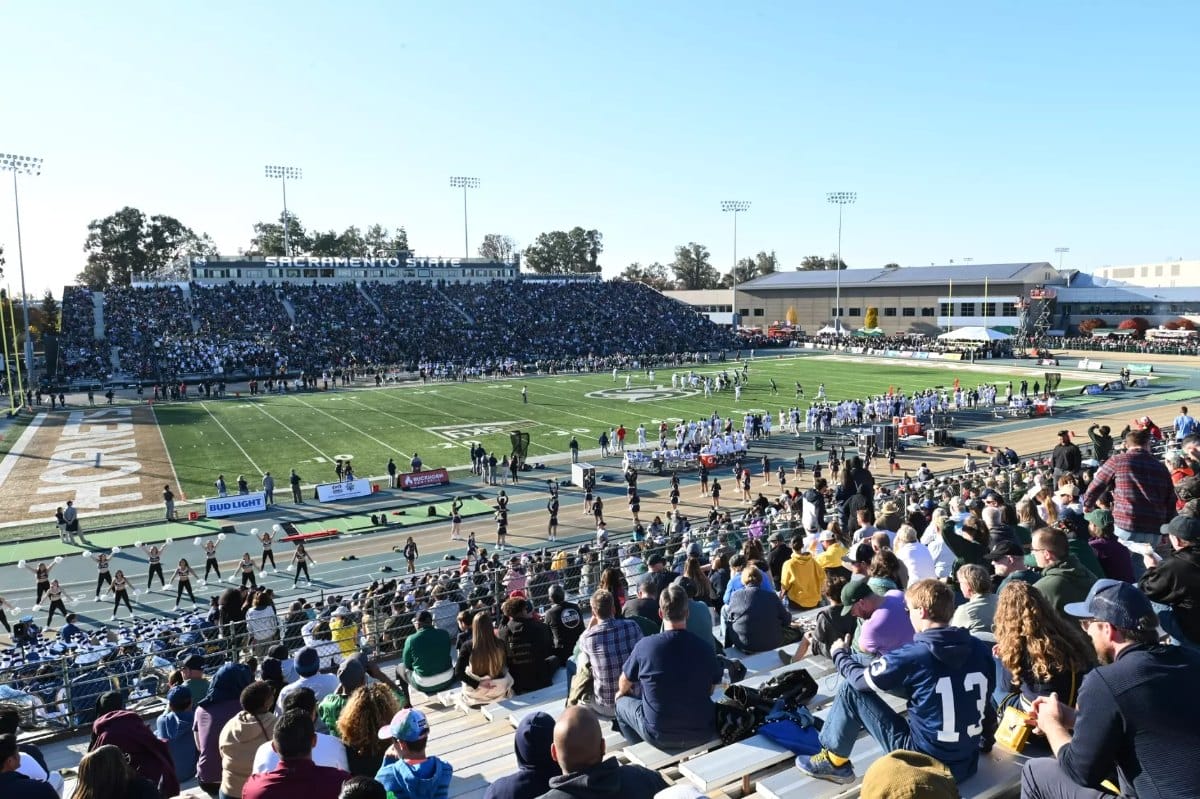
Sacramento State
Even with the recent announcement of Sacramento State to the MAC, I will still include their financials below because I think it is important and, in a roundabout way, it could make them attractive to a league like the PAC (or MWC) in a few years.
The FBS conversation might shift behind the scenes toward geographic alignment. I would imagine their deal with the MAC includes some serious stipulations if they were to bolt again in the next few years. However, after a few seasons in the MAC, will they be attractive enough to make another conference move?
2024 Financials
Total expenses: $43.8M
Football expenses: $7.2M
The Wrap Up
Overall, I love the moves for both NDSU and the MWC, but I think the ball is now in the PAC’s court for a football move. There are more options than the ones listed above, but those are the first that others have mentioned to me. The PAC can and should be calculated in all of this, but I do think a move will be coming at some point.