

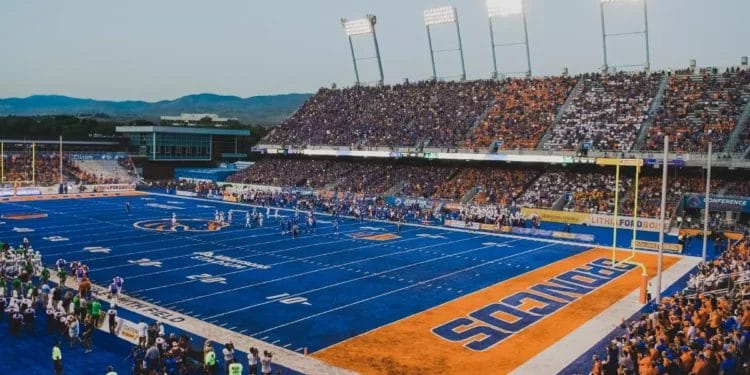
Matt Brown at Extra Points released the FRS reporting numbers for Fiscal Year 2025, giving us a better look at spending tied to the 2024 football season.
An FRS report, sometimes referred to as an MFRS report, is the annual financial submission required from NCAA member institutions through the Membership Financial Reporting System. It details athletic department operating revenues, expenses, capital expenditures, and other data, including student aid and sports sponsorship, to promote transparency and compliance with NCAA rules. Division I schools also pair the report with independent Agreed-Upon Procedures.
It is not a perfect data set. It can be skewed in certain areas by institutional reporting, accounting structure, facility expenses, or how costs are categorized. But it is still the best comparative tool we have across college athletics.
We are compiling the numbers and building them into what the Pac-12 will look like on July 1, 2026, offering a glimpse at where schools currently sit and where some may need to make adjustments.
Major hat tip to Brown and Extra Points Library for doing the legwork on requests to schools and compiling the information. These are expenses reported to the NCAA, due in January each year, and required of every Division I school. Private schools and some public schools are not required to disclose this information through FOIA or open records requests.
For additional context, five of the Mountain West’s top six spenders are moving to the rebuilt Pac-12, with UNLV remaining in the Mountain West after reporting $21,767,260 in football expenses.
FY25 Football Expenses
Colorado State: $37,791,844
Boise State: $30,738,142
Oregon State: $23,847,864
Texas State: $23,116,059
Washington State: $22,896,017
San Diego State: $22,274,018
Utah State: $22,101,735
Fresno State: $17,970,586
Average: $25,092,033
It is also probably safe to assume that most, if not all, of these budgets have already increased. A conservative 5% bump would move the average to roughly $26.35 million. Between FY24 and FY25, both Utah State and Boise State saw major year-over-year increases, with Utah State jumping 18% and Boise State increasing 20%, according to Extra Points.
Overall, the 2024 football season closely reflected spending. Boise State, UNLV, and Colorado State all finished near the top of the Mountain West standings, with Boise State and UNLV meeting in the championship game. Colorado State led this future Pac-12 group at $37.8 million, though the Rams included roughly $13.4 million in Canvas Stadium expenses in their football budget, and stayed in the league race until late November. Boise State ranked second at $30.7 million and turned that investment into a conference title, College Football Playoff bid, and Top 10 finish.
Bowl eligibility also followed many of the same spending trends. In the Mountain West, Colorado State, Boise State, Fresno State, San Jose State, and UNLV all reached bowl eligibility during this reporting cycle. Washington State was bowl eligible out of the two-team Pac-12, while Texas State reached bowl eligibility as a member of the Sun Belt.
For the current two-team Pac-12, Washington State went 8-5, while Oregon State finished 5-7. Texas State, which is also joining the rebuilt league, went 8-5 in 2024.
In recent days, there has been no shortage of financial information disclosed about the Pac-12’s rebuilt era. The next two years will be even more telling, but even based on some of the data we can see now, including head coach salaries, there are already signs of where expectations and potential budget hits may be coming from.
One example is Oregon State. Jonathan Smith’s deal topped out at roughly $4.85 million in 2024, while Trent Bray’s 2025 salary was $2 million. New head coach JaMarcus Shephard is set to make $1.6 million.
As noted in a previous article here on HERO Sports, UConn, which has long been rumored as a Pac-12 football candidate, reported $20,651,432 in football expenses, according to Extra Points. For other comparison purposes, Memphis reported $24,770,267, and UTSA reported $19,277,444.