

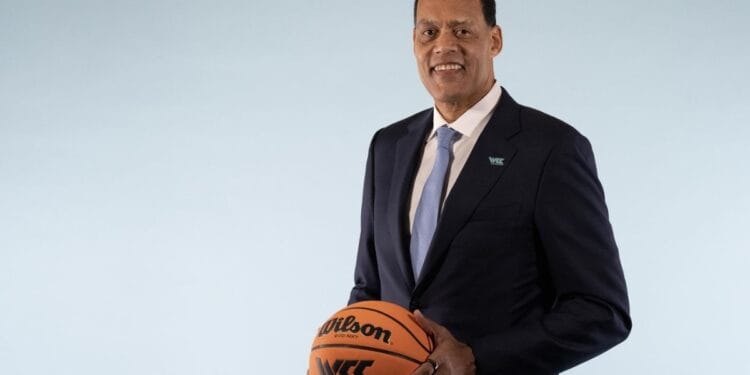
Stu Jackson loved the UCLA cut.
The pass to the wing, followed by a hard cut off a high-post screen. Smart movement. Wide spacing. A simple action that could become far more complex depending on the read, timing, and the defender’s mistake.
It was one of Jackson’s favorite actions as a player at Oregon and Seattle. It followed him into coaching, too, from his days with the New York Knicks to Wisconsin and the Vancouver Grizzlies. Some call it Hawk. Some call it horns. Jackson still calls it the UCLA set.
For Jackson, the appeal was not just the action itself. It was the design. It looked simple from the outside, but inside the possession, there were options everywhere.
That is not a bad way to understand the job he now holds as West Coast Conference commissioner.
“I feel like becoming commissioner of the West Coast Conference is a culmination of many of the positions that I held previously,” Jackson said.
Jackson was appointed the fifth full-time commissioner of the league in March 2023 and officially began on April 24, 2023. Before that, he spent nine years at the Big East Conference, most recently as executive associate commissioner under Val Ackerman. He also worked in the NBA league office, served as president and general manager of the expansion Vancouver Grizzlies, and coached at multiple levels, including Wisconsin and the New York Knicks.
Jackson did not arrive at the commissioner’s chair in a straight line. He arrived after decades inside locker rooms, front offices, league offices, conference rooms, and board rooms.
He believes each stop left something behind.
“Most recently, I had the opportunity to be a part of the Big East Conference as an executive associate commissioner, working alongside Val Ackerman, which was a true godsend,” Jackson said. “And prior to that, I spent a number of years in the NBA league office, in basketball operations. Again, fortunate to have the opportunity to work alongside some of the best leaders in sports.”
Those leaders shaped the way he views the job. Jackson mentioned Ackerman, David Stern, Russ Granik, Joel Litvin, and Rick Pitino as people who influenced his approach.
The common traits, he said, were not accidental.
“They all had very good vision,” Jackson said. “They were strategic in their thinking. They made decisions based on both their gut instinct and analytics. And they all created a culture that allowed staff who worked with them and for them to flourish.”
Jackson’s résumé includes enough high-profile stops to fill a media guide bio. He was the second-youngest head coach in NBA history when the Knicks hired him in 1989, according to the WCC’s announcement of his hiring. At Wisconsin, he led the Badgers to their first NCAA Tournament berth in 47 years. He later became the first president and general manager of the Vancouver Grizzlies.
But when asked what he had taken from the leaders around him, Jackson did not start with titles, trophies, or power.
He started with vision, strategy, and culture.
That is the connective tissue in Jackson’s career. He has been a player. He has been a coach. He has been an executive. He has worked in college athletics, professional basketball, and conference administration. But all of those roles required the same basic skill: moving people toward something before the outcome was obvious.
The UCLA cut works because someone sees the play before it opens.
A commissioner’s job now requires the same thing.
When Jackson accepted the WCC job in the spring of 2023, college athletics were already changing. NIL was here. Revenue sharing was coming. The transfer portal had already reshaped roster management. But even then, the job had not yet become what it is today.
“It’s changed immensely,” Jackson said. “When I accepted the position here, you may recall in the spring of 2023, the notion of NIL and revenue sharing was at the forefront. It hadn’t really impacted the industry the way that it has now.”
Then came more.
The transfer portal’s impact stretched beyond basketball. Revenue sharing moved from a talking point to a defining operational issue. National realignment accelerated. The Pac-12 broke apart. Conference offices had to think less like schedule-makers and more like strategy firms, media companies, legal analysts, and membership architects.
“When I accepted the position here, no one could have predicted that we would be in a place where we are today in those two areas,” Jackson said, referring to the portal and realignment. “And as I like to affectionately say, the job I accepted in April of 2023 is not the job that I have now, and it’s not even close.”
That line lands because it is true across the industry.
The modern commissioner’s office is no longer just about championships, officiating, governance, and scheduling. Those responsibilities still matter, but they sit inside a much larger job. Commissioners are now expected to help presidents understand risk, athletic directors understand opportunity, coaches understand competitive pressure, and fans understand why the ground keeps moving.
“We are navigating so much more right now, the ball game has changed so much with revenue sharing and name, image and likeness,” said Jackson. “Even when I started, it was just starting to get going. It’s now the center of the conversation, especially as we are centered in basketball at the West Coast Conference.”
In Jackson’s case, he also walked into a league with a proud basketball identity and a changing membership picture. But the leadership challenge, at least in his telling, is less about reacting to panic and more about repeating the right message until people understand where the conference is going.
That is where “Coach Stu Jackson” still shows up.
When asked for advice to the next generation of sport administrators, Jackson’s answer sounded like it came from someone who still thinks in terms of practice habits.
His first piece of advice is to develop a diverse skill set.
“Play a role in any area of this business that you can in collegiate athletics and develop a toolbox that allows you to be fluent in a number of different areas in collegiate athletics,” Jackson said.
The second piece is even simpler.
“Be an individual who gets things done in a way where you overdeliver what is asked of you,” Jackson said. “Because I believe leaders in this industry are continually looking for individuals, regardless of their academic background, regardless of their degree pursuit. At the end of the day, you want someone that’s going to be a net positive and have added value to your organization, being able to, quote unquote, get things done.”
That is not complicated advice. But then again, neither is a hard cut-off a high-post screen.
The complexity is in doing it correctly every day.
Jackson still enjoys being called a coach. In fact, he said it warms his heart.
“When you make that choice to coach, you really do make a decision to lead,” Jackson said. “But the interesting part about coaching any sport, no matter what walk of life you eventually gravitate to or go through, people still call you coach.”
There are no technical fouls in the commissioner’s office, he joked.
“You just have different officials,” Jackson said. “They’re called presidents and sometimes fans,” he continued to laugh.
The humor continued when Jackson joked about Denver’s addition. With the Pioneers’ recent run of national championships, including three of the last six and the 2026 title, Jackson said the real reason for adding Denver was simple: he wanted the West Coast to be known as the center of the college hockey world.
And at 6-foot-6, Jackson will almost certainly be hard to miss when he eventually puts on a Denver hockey jersey at some point in the next few years.
Jackson today is not simply calling plays. He is managing a room full of presidents, athletic directors, and institutional priorities during one of the most volatile stretches in college athletics history. The decisions are bigger. The consequences are more public. The margin for error is smaller.
And yet Jackson’s leadership style still appears rooted in the ideas that shaped his playing and coaching.
Spacing matters. Timing matters. Vision matters. So does trust.
A good UCLA cut doesn’t work if one player or institution moves while the others stand still. The pass has to come on time. The cutter has to commit. The screener has to be in the right place. The floor must be balanced enough to create space, but connected enough to create pressure.
That sounds a lot like a conference office in 2026.
Jackson may have accepted one job in April 2023. He is doing another one now. But the leadership principles have not changed much.
See the floor. Make the read. Trust the action.
Then cut hard.
