


A few times a year, a fan base gets a stark reality check about how their own marketing and trademark offices on campus actually work. Right now, fans of NC State University are the latest recipients of the familiar question: “Why can’t we use this logo or that uniform?”
The answer usually isn’t found inside the athletic department.
For more than half of Division I institutions, those decisions are made far away from athletics.
Quick NC State context, then I’ll let you read a story I wrote years ago for the now-defunct (RIP) Uni Watch site. On Will Wade’s weekly radio show, he spoke about uniforms and said he wanted to wear the “slobbering wolf” throwback logo more often, but couldn’t because the university pushed back.
From the transcript:
“I mean, I like the retro uniforms. We should wear them. We’ve played well in them both times we’ve worn them. I think it connects us to our past, connects us to our history…
“I mean, look, it’s a bureaucracy like anything. There’s so much red tape, there’s so much stuff you’ve got to go through. But I like the uniforms…
“I like to ask for forgiveness, not permission. We got a scathing email from the University after our first game. They were not happy.”
What followed was predictable: a social media firestorm, FOIA requests, and scathing emails from fans sent to random people in marketing and communications. A simple radio show comment — slightly taken out of context — blew up into something much bigger.
When the full email response was requested through open records, the core issue wasn’t actually the slobbering wolf logo. It came down to this:
“The use of these marks causes brand confusion when there is no story or reasoning for using them.”
Specifically, the concern was that “STATE” alone on a jersey was not on-brand. The Brand Police was on the hunt.
For what it’s worth, Will Wade did apologize and asked fans to back off the topic in his postgame comments.
From the perspective of a marketing or trademark office, the brand is viewed as a standalone identity — not through the lens of a sports fan. In the context of a basketball game, fans know exactly what “STATE” in red and white means. They see the ACC patch, the scoreboard, the NCST acronym, and fill in the blanks with context.
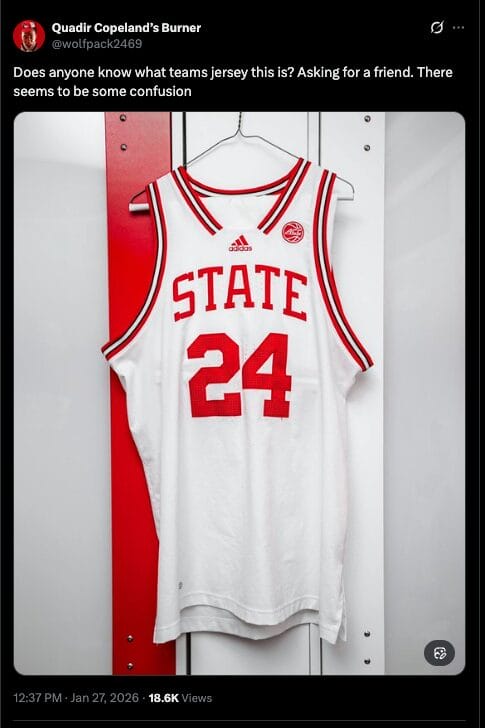
But branding offices are trained to look at it differently.
They’re taught (as I was) to imagine someone walking around in Abu Dhabi or Buenos Aires wearing that shirt or jersey. Would the brand still be clear? Would it still communicate the institution’s identity?
Is that the right way to think about it? Probably not.
But it is the dominant way universities think about brand and trademarks today. And as much as I hate to admit it, there are more non-sports fans than sports fans in the world. Maybe we’re the ones looking through the wrong lens. Maybe.
Anyway — enjoy this story from 2024. It’s a topic I love and care deeply about.
—
I’m still waiting for the brand police to come and arrest me.
As you know, sports fandom is at an all-time high. It dominates TV, social media, and our daily lives—right down to the ongoing online debate about fall weddings.
Before diving into the “hidden” roadblocks that often derail the creativity of collegiate athletic departments, let me give you a quick background.
I spent 12 years in collegiate athletics, working in nearly every facet of a department’s external, revenue-generating areas. My career progressed quickly, and I eventually oversaw everything from the men’s basketball program to fundraising and everything in between. We’ll get back to that “in-between” in a second.
Now, I teach as an adjunct professor and run Athletics Admin, a contract and consulting company. I work with various athletic departments to generate revenue, assist in coaching searches, solve problems, run awesome contests, and even negotiate apparel contracts for half the cost of the big guys (there is my shameless plug). But back to the in-between responsibility.
The in-between often goes unnoticed, yet it’s a crucial function of any college campus: Licensing.
I had some experience in licensing, but when I took over my role at Southern Utah University, I also took on responsibility for the entire campus’s licensing operations, down to the T-shirts the admissions office prints for prospective students. That role fell to me, a random guy in the athletics department, acting as the liaison between the university and the Collegiate Licensing Company (CLC). CLC is the biggest player in the landscape, representing over 700 colleges, universities, bowl games, athletic conferences, 4,000 manufacturers, and 100,000 retailers nationwide. It wisely encourages collaboration between athletic departments and campus entities but prefers to work through a streamlined communication process.
Jacob Krebs, Senior Manager of Partnerships at CLC, highlighted the diverse range of university departments that handle collegiate licensing. “Collegiate licensing can sit in various departments across a university, including athletics, business/auxiliary services, university marketing and communications, the legal department, alumni relations, or others,” he explained.
Krebs also shared that, for CLC’s partner institutions, roughly 60% of licensing programs are managed by university-focused departments, while around 40% fall under the purview of athletic departments.
You might wonder: Is it normal for an athletics employee to manage what goes through the bookstore and even pops up at your local Wal-Mart?
The answer: It’s a dying breed.
Universities now realize that Marketing & Communications offices need to be included in brand direction and, more importantly, the money from royalties. The liaison role is now often handled by on-campus administration, which is probably the best move, though I hate to admit it.
The kicker is that your MarCom or other central university offices aren’t athletics folks. Even as a consultant, some of my initiatives get kicked back because they’re “not on-brand.” Even if it’s a retro school logo, it’s not on-brand to look back—the focus is on current marks. That fun promotion that includes a t-shirt giveaway in funky, neon colors? Yeah, that’s not happening–even if coaches can do it. (True Story)
I once witnessed an in-person showdown and an epic email thread between a head football coach and “some random person” who wouldn’t allow the term “no-fly zone” on a defensive back shirt with the athletic logo because it wasn’t “on-brand.” Explaining to someone who probably didn’t play sports growing up—or maybe was cut from T-ball—what a defensive back does against an “air raid” offense is sometimes a challenge. I know some athletic departments skip over the licensing office on campus altogether. That right there is a whole other subject. Trust me when I say this: Campus administrators love to keep receipts when athletics go rogue.
There’s another layer to all this: the bookstore. The bookstore purchaser or designer doesn’t want to be told their design is denied or what apparel they can only buy via the athletics department. Bookstores are outliers for various reasons, but they are essential to the brand and marketing experience.
Krebs emphasized the importance of collaboration between licensing and athletics, stating, “For most of our partner institutions, there is strong collaboration between licensing and athletics, as both have similar goals of reaching the consumer and growing their brand. While collegiate licensing can be very fan- and sports-driven, many alumni have strong allegiances to their institution due to academic pride, and they’re not buying collegiate licensed merchandise for sports.”
He further pointed out that critical sales periods like back-to-school and graduation are not solely focused on sports, making it crucial for licensing programs to consider broader consumer interests. “Regardless of the target consumer or where licensing sits on campus, we always encourage regular communication between licensing and athletics or the academic side to ensure everyone is on the same page to maximize marketplace opportunities.”
Going back to my time at Southern Utah University, we had success: Royalty sales jumped more than 200% in some areas, the bookstore and athletics established a working relationship, did some funky things, and I was threatened with the brand police multiple times by graphic designers and a few employees.
However, although some “chief licensing officers” or CLOs take their role a little too seriously at times, especially in athletics, I always included our MarCom team. I never felt comfortable denying or accepting a submission from the College of the Arts or the President’s Office.
Although the kickback came from my email, I had the reasoning and contact info from our MarCom team. I must shout out to Nikki Koontz, the assistant vice president of marketing at SUU. She was a tremendous asset to me every single day.
Richard Fairchild, Associate Director of Auxiliary Business Development at the University of Utah, explained their unique structure: “Trademarks & Licensing at the University of Utah resides outside of Athletics. That said, the partnership between the two departments is crucial to the retail licensing program’s success. It takes a lot of coordination to align uniforms on the field with retail releases, ensuring they aren’t unveiled prematurely.”
As a side note here, Utah’s Trademark & Licensing office is elite. They are very respected in the industry. That crew is creative and truly understand the spirit of collegiate athletics. From their innovative projects to their fun collaborations with Under Armour, they are expanding the proverbial “box.”
Fairchild also highlighted the delicate balance of trademark protection, collaboration, and joked that a big misconception is that they are “the ‘no’ office, but at Utah.”
“True partnerships require give and take. While we have to protect our trademarks, our first approach is to help infringers understand licensing and bring them into the fold. That goes for everyone—across campus, with existing licensees and retailers. Let’s get them excited about the space we’re in and help each other be more successful.”
Overall, collegiate athletics should be fun and entertaining. If done correctly, athletics can bring tremendous value to a university and not just be a money pit. If operated correctly, it’s probably a university’s number one marketing tool. Athletics can enhance the brand, and vice versa. The off-brand aspects, every so often, are where the fun and entertainment come in.
And until the brand police start making arrests, let’s enjoy the ride.

